
North Carolina State University Athletics
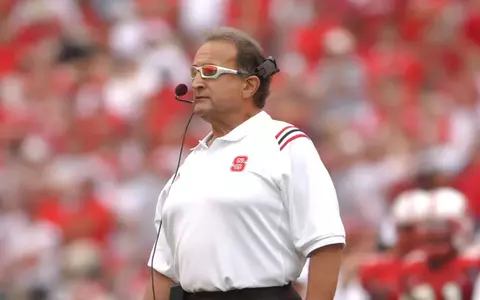
Pack Mourns Loss of Iconic Former Head Coach Chuck Amato
10/19/2026 3:02:00 PM | Football
It took a while before Chuck Amato could be convinced to play football at NC State. It took even longer — more than 20 years — before the university was convinced, in 2000, to hire him as its its head football coach.
For seven seasons (2000-2006), the scrappy two-sport star and two-time NC State graduate from Easton, Pennsylvania, lived his dream, leading his alma mater to the best record (11-3) in school history in 2002, taking the program to five bowl games in his first six seasons and producing iconic players like quarterback Philip Rivers and linebacker Dantonio Burnette, among many others.
Amato, who died early Monday morning at age 80 at his home in Raleigh under hospice care, was an old-school character who spanned multiple decades of NC State athletics: a decorated linebacker and Atlantic Coast Conference champion wrestler in the 1960s, and a Wolfpack assistant for head coaches Earle Edwards, Al Michaels, Lou Holtz and Bo Rein in the 1970s. He went on to serve as a premier coordinator and associate head coach under Florida State's Bobby Bowden.
Hours after helping Florida State win the 1999 college football national championship, he was hired as head coach of the Wolfpack, a position he had interviewed for on three different occasions. He is the only NC State graduate to lead the program in more than 100 years.
"Chuck was one of those people that if you played against him or rooted for a different team, you might be intimidated by him or maybe not like him," said former player, assistant coach and longtime friend David Horning. "But if you knew him, you loved him.
"And I loved him."
Mourned By Many
Former staff members, administrators and players mourned the loss of the coach that brought excitement to the program through his motivation and experience as part of several Top 10 programs.
Many of them had been in touch with Amato since his retirement from coaching in 2018 as he struggled with his health and lost his voice due to throat cancer that first began when he was an associate head coach at Akron.
Six years ago, before he lost his ability to speak, Amato had heart-to-heart talks with dozens of his former players, as Horning drove him to Canton, Ohio, for the induction of former NC State linebacker and Pittsburgh Steelers head coach Bill Cowher into the Pro Football Hall of Fame.
"He spent the whole way up there and the whole way back talking to his players," Horning said. "He meant so much to them, and they meant so much to him. They were all able to tell him that."
Amato wasn't seen in public much after that, though he did attend Rivers' induction into the NC State Athletic Hall of Fame in 2024, and he made weekly trips near campus to have coffee and lunch with NC State friends and family.
With every sip and every bite, those friends were reminded of the attitude he brought to the program.
"He was just a dreamer," Horning said. "He always said: 'Why not? Why can't we do this?'"
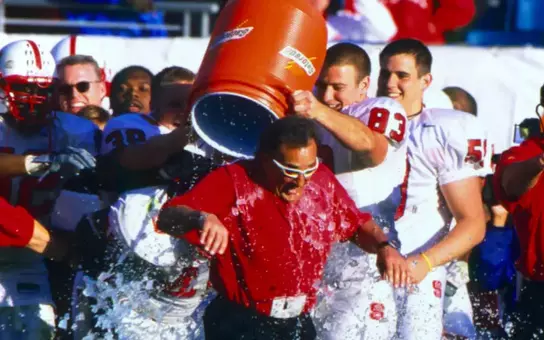
The 2002 Wolfpack accomplished more than any other team in school history, finishing with a program record 11 victories and beating heralded Notre Dame in the New Year's Day Gator Bowl. Amato's teams were 49-37 in his seven seasons, with additional postseason victories in the MicronPC.com Bowl in Fort Lauderdale, Florida; the Tangerine Bowl in Orlando; and the Meineke Car Care Bowl in Charlotte.
Burnette, who was recruited out of high school by Amato to play at Florida State, spent three years under the coach at NC State.
"He played a huge role in my life and left a big impact on the way I have carried myself. Even to this day.
"I was so excited when he came here and I was able to play for him," said the current assistant athletics director and director of strength and conditioning for football. "He made us believe things we could not see with our own eyes. If he was to tell us to go run through that wall, that there was something on the other side, you best believe we would go run through it.
"He made us believe we could beat any team that we played against, no matter where it was. My junior year, we went down to Florida State and beat them, and then again the next year. That was just a testament in his ability to influence young men and teach us how to believe in things that were bigger than ourselves.
"He made us believe we belonged on the big stage."
That was a common theme of Amato players at NC State: undersized or overlooked players who did big things once they arrived in Raleigh.
"He pushed us to limits that we didn't know we had," said former captain Clayton White. "He brought so much personality and persona to NC State, and we were all so proud of that.
"He had us believing that we were top dogs, and we played like that."
There was also a personal touch that Amato brought to all of the programs where he coached, a joking side that allowed him to laugh and enjoy his players and a serious side that pushed each one.
"I grew up without a father, and Coach Amato was a father -figure to me," Burnette said. "He had twin daughters, and all of his players were his sons.
"He didn't always make it easy on us, but he made sure we understood that we would be able to make it through the tough times in our lives — he always taught us that iron sharpens iron."
A Lifelong Wolfpack Legend
Amato's beginnings at NC State dated back to his senior year at Easton High School. At first, he wanted nothing to do with the university where his older brother, Rosie, played on the Wolfpack's defensive line. After years of following in his older brother's footsteps, young Chuck thought he might be better off at Syracuse or Penn State, schools that had already told him he could play football and wrestle during his college career without that long shadow hanging over him.
He even thought about attending Duke, where he could have played football, wrestled and pursued his youthful ambition of becoming a dentist.
On the day Edwards first met the younger Amato, at the 1963 Liberty Bowl in Philadelphia, the player was so emaciated because of dropping weight for wrestling that assistant coach Michaels hid him from the head coach.
"Son, don't let Coach Edwards see you," Michaels said in horror in the locker room that afternoon. "How much weight did you lose?"
The answer was more than 30 pounds, from his football weight of 195 to his wrestling weight of 165.
In the end, it didn't matter — Edwards was convinced that the linebacker would be the leader of what became the most famous defense in school history. Amato eventually fell in love with NC State, but only after he secured the promise that he could participate in both his favorite sports.
Edwards never complained about Amato's stature, mainly because the fiercely competitive linebacker played with a heart so big it never quite fit under his shoulder pads.
Amato created his adoptive family and his biological family here in Raleigh. He was adopted by players who had previously made their way from Pennsylvania to North Carolina. And he started his own family with wife and Raleigh native Peggy Brown, with whom he had twin daughters, LuGina and Selena. And he couldn't have been more devoted to the state's largest university, where he earned a Bachelor of Science in math in 1969 and a master's degree in education 1973.
"His heart is here," said former Wolfpack football player and Western Boulevard restaurant owner Amedeo "Dick" DeAngelis, a longtime family friend, on the day Amato was hired. "I think he is going to rejuvenate this program."
And he did, both on the field and in the stands.
Amato returned to his alma mater with the promise that the school would begin fundraising and construction on long-discussed renovations at Carter-Finley Stadium, where he played in the inaugural game in 1966 and where few improvements had been done in the succeeding 35 years.
After his first year, the athletics department embarked on a campaign that made a $120 million investment in the facility, adding luxury suites in a towering new press box, a football operations center, practice fields and other top-notch facilities.
That promise was on Amato's mind the day he was introduced, as he choked up twice during his introductory news conference when talking about mentors Edwards and Michaels, the architects of NC State's most successful era in football, and the two-decade wait to land his dream job.
"My wife told me to remind you all that it took Susan Lucci 18 years to finally win an [Emmy]," Amato said before pausing to compose himself. "It took me 20 years to win my Oscar: the head football coaching position at this school."
White Shoes Beat Tar Heels
Long before he became head coach, Amato put an indelible, sparkling white mark on NC State's football program.
The night before the 1967 season opener, when the Wolfpack played North Carolina and Duke played Wake Forest in the only double-header in Carter-Finley Stadium history, Amato sat in a team meeting in the second floor of the school's infirmary and convinced his fellow defensive players to paint their shoes white, mimicking the footwear of NFL quarterback Joe Namath.
One of his teammates wanted to wait until after the game so it wouldn't embarrass NC State if the Wolfpack lost.
Amato was in his teammate's face in seconds, breathing garlic and fire from his mouth.
"You think we are going to lose?" Amato screamed. "If you think we are going to lose, then you are not dressing for the game, let alone putting on white shoes."
The Wolfpack beat the Tar Heels the next day, 13-7, and the "White Shoes Defense" was born.
It became legend three weeks later, when the Wolfpack faced No. 2 Houston in the world-famous Astrodome. Because it was NC State's first game on artificial turf, the team had to borrow soccer shoes to wear, and there was some debate over whether they should paint the borrowed shoes the night before the game.
"Charlie, if you want to paint those shoes white, you go right ahead," Coach Edwards told Amato, using his affectionate nickname for his senior middle linebacker.
"Coach, I don't care if you give us permission or not, they are already painted," Amato replied.
For the next five games, the Wolfpack was unbeatable and the defense was impenetrable, never giving up more than a touchdown en route to an 8-0 record and a No. 3 national ranking, the highest in school history.
Big Names Relied on Amato
Two of college football's greatest coaches relied on Amato for a significant portion of their success. When Amato was hired in 2000, Florida State coach Bobby Bowden said he couldn't have made it this long without Amato running his program for the last 18 years as the Seminoles' assistant head coach.
"I don't know anybody more qualified to be a head coach than Chuck Amato," said Bowden, who had known Amato since his college playing days. "For years, he has done a lot of a head coach's job here because I have turned so many responsibilities over to him. He is one of the big factors that has allowed me to coach at my age.
"I threw a lot at him, and he didn't dodge any of it."
Nothing made the late Bowden prouder than when Amato's Wolfpack became the first ACC foe to beat the Seminoles, 34-28, on their home field at Doak Campbell Stadium in 2001 in his first trip back to Tallahassee as a head coach.
Lou Holtz hardly ever elevated student assistants to full-time coaching positions, but Amato was an exception. After spending one year as a graduate assistant under Holtz, Amato was named the defensive secondary coach for the Wolfpack in 1973. Eventually, he became Bo Rein's defensive coordinator, the position he held when the Wolfpack won its most recent ACC football championship in 1979.
"He is a great coach, very innovative, very aggressive," said Holtz in 2000 when he was the head coach at South Carolina. "He was great at solving problems, breeding enthusiasm and leading the team. He did a tremendous job for me."
Competitive In Everything
Amato's Italian blood rarely accepted losing in any form, whether it was a football game or his daily lunchtime workout that created the muscular form he carried with him throughout his coaching career.
Former Wolfpack Club Executive Secretary Charlie Bryant remembered some cut-throat lunchtime handball games between himself, Amato and former running back Willie Burden during the mid-1970s.
"The most memorable thing about Chuck is that he just wouldn't accept defeat," Bryant said. "He was always a fierce competitor in everything he has ever done. He is so passionate, and he carries that passion with him everywhere he goes."
Amato prided himself in not making excuses. He was never one to let physical limitations hold him back, as a football player, a wrestler or a weightlifter. Not only did he help the Wolfpack share the 1965 ACC football championship, he also won two ACC wrestling titles during his career. In all, he won 13 ACC championships in some form or another with NC State and Florida State.
"He was the shortest linebacker I ever saw," said former NC State All-America defensive lineman Dennis Byrd, who was a member of the White Shoes Defense. "He had some ability, but he was awfully short. What he had, though, was the biggest heart I have ever seen in a player.
"That's what made him a great leader for us."
Plus a positive attitude that he spread among everyone around him.
"He's hard to beat at anything," Bowden once said. "A lot of times, we would be getting ready for a big ball game and our coaches would be talking about, 'Oh, it's going to be tough, and I don't know how we can do it.'
"I would go grab Chuck when he was by himself and say, 'What do you think, Chuck?' He would always say, 'I think we are going to beat their you-know-whats.' That's typical [of] Chuck Amato."
Funeral arrangements for Amato have not yet been finalized.
By TIm Peeler
University Communications

Monday, October 19
Saturday, October 10
Saturday, October 10
Monday, October 05